In many buildings, emergency lighting is checked not only by the operator but also by outside bodies: fire safety authorities during routine fire inspections and, for buildings with special use, independent certified experts. In Germany, state inspection ordinances typically require expert inspection before first use and then periodically, often every three years. Inspectors look at both the installation and its records, and serious defects can lead to a prohibition of use.
Which external inspections are there?
On top of the operator's own tests (monthly function test, annual duration test, see testing intervals), most European countries have some form of external control. Who inspects, how often and on what legal basis is national or even regional. Germany shows the typical layers:
| Inspection | Who inspects | Legal basis (Germany) | Typical trigger |
|---|---|---|---|
| Fire prevention inspection (Brandverhütungsschau, Feuerbeschau) | Local fire safety authority | State fire service and fire protection laws | Recurring, in buildings with increased fire or occupancy risk |
| Inspection of technical installations | Certified expert for electrical installations (Prüfsachverständiger) | State inspection ordinance (e.g. PrüfVO, TPrüfVO, SPrüfV) | Special buildings: before first use, after major changes, periodically |
| Building control acceptance | Building authority | State building code, building permit | Completion, start of use |
| Workplace safety inspection | Occupational safety authority, statutory accident insurers | Occupational Safety Act, Workplace Ordinance | Random checks, incidents |
Other countries organise this differently: some rely mainly on fire authorities, others on accredited inspection bodies or insurers. Property insurers and landlords may also require inspections through policy terms or leases. National overviews are in emergency lighting in Europe.
What is a fire prevention inspection?
A fire prevention inspection is a site visit by the fire safety authority to check whether a building prevents fire hazards and allows safe evacuation and effective firefighting. In Germany the name varies by state: in Bavaria it is called Feuerbeschau, elsewhere Brandverhütungsschau or Brandschau.
Which buildings are covered and how often is set by state law. Typically these are buildings with many occupants or higher risk, such as places of assembly, shops, hotels, hospitals, care homes, schools and larger commercial premises. Intervals usually span several years, depending on the state and the building.
Emergency lighting is one item among many. Fire inspectors rarely test each luminaire electrically; they look at the overall picture: are escape routes clear and signed, are exit signs visible, does the safety lighting work, are the test records available?
What do certified experts check?
For special buildings, the German states require certain safety installations to be inspected by certified experts (Prüfsachverständige): specialists recognised by the state building authority who inspect and certify on behalf of the operator. The ordinances have different names in each state, such as PrüfVO, TPrüfVO or SPrüfV.
Safety lighting and the safety power supply are generally among the installations to be inspected. Following the model ordinance, inspections typically take place:
- before first use
- without delay after a major change
- periodically, often every three years
Which buildings are covered and which intervals apply depends on the state and the building permit. The operator commissions the inspection; the result is recorded in a report, and any defects must be remedied.
Practical tip: Put the due date of the expert inspection into the same calendar as your own test dates. The periodic interval runs from the last inspection and is easily missed when the operator or facility manager changes.
What do inspectors look for in emergency lighting?
Whether fire authority or certified expert, inspectors compare the installation with the requirements of the building permit, fire safety strategy and standards. Common checkpoints are:
- Completeness: are all luminaires and exit signs specified in the fire safety strategy installed?
- Function: do luminaires switch over on mains failure, are all exit signs lit?
- Duration: does the installation achieve the required rated duration, as shown by the last duration test?
- Visibility: are exit signs visible, unobstructed, correctly oriented and designed to ISO 7010?
- Match with the building: do escape routes and signs still match the actual layout after refurbishments?
- Records: is there a complete logbook with all function and duration tests?
- Remedial work: have defects from earlier inspections demonstrably been fixed?
- Central battery systems: battery condition, indicators, circuit integrity of cables, condition of the battery room.
For many inspectors, a working installation without complete records is already a defect. How a logbook should be structured is explained in emergency lighting logbook.
How do you prepare for an inspection?
Good preparation shortens the inspection and avoids follow-up visits. This checklist has proven useful:
- have the building permit, fire safety strategy and escape plans ready
- present the logbook for recent years, complete and in order; for digital systems, a current export
- add the last expert inspection report and evidence that defects were remedied
- carry out your own function test a few days before and record the result
- avoid a full-duration test immediately before the visit, so that batteries are fully charged
- walk the escape routes: signs unobstructed, luminaires undamaged, no storage in corridors
- list all changes since the last inspection (refurbishments, new partitions, change of use)
- make sure all areas, plant rooms and, where relevant, the battery room are accessible
- name a competent contact person who knows the installation
Self-testing luminaires to EN 62034 make preparation much easier because records of every function and duration test already exist. With NOTLUX emergency lighting these records can be exported as a test report via the app. See self-testing emergency lights.
What happens if defects are found?
The consequences depend on how serious the defects are. A graduated response is usual:
- Minor defects are noted in the report and must be fixed within a set deadline, for example a faulty exit sign.
- Significant defects lead to a re-inspection; the authority can order remedial work and enforce it.
- Danger to life and limb: if escape routes cannot be used safely in an emergency, the authority can prohibit use of the building or parts of it. This can mean the temporary closure of a business or venue.
Fines may also apply, and unresolved defects matter for liability and insurance cover if damage occurs. See operator duties and liability.
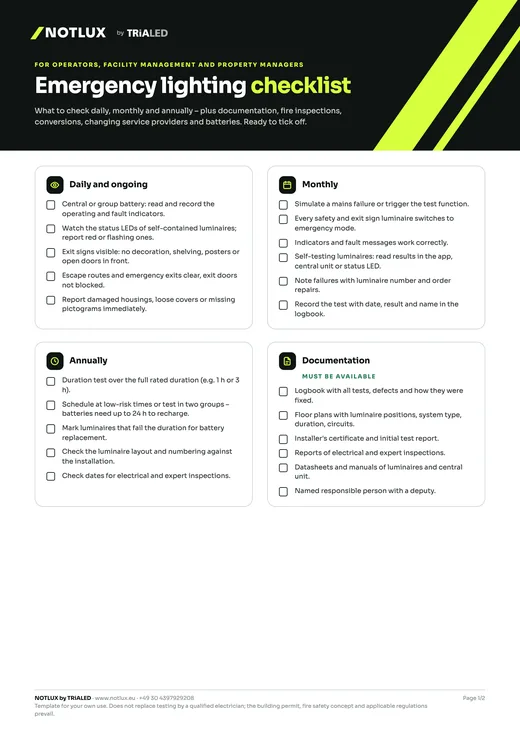
Emergency lighting checklist
2 pages to tick off: daily, monthly, annually – plus documentation, fire inspections, conversions, changing service provider and battery age.
Download PDFFrequently asked questions
How often do fire inspections take place?
That depends on national or regional law and on the type of building. Intervals of several years are common, shorter for high-risk buildings. Your local fire safety authority can tell you the interval for your property.
Who pays for the expert inspection?
The operator or owner normally commissions and pays the certified expert. Depending on local law, fire authority inspections may also be subject to fees. The cost of remedying defects is borne by the responsible party as well.
Does the expert inspection replace the operator's own tests?
No. The expert inspection is an additional periodic check. The monthly function tests and annual duration test under EN 50172 remain the operator's responsibility.
Does every building need an expert inspection?
No. In Germany, inspection by certified experts mainly applies to special buildings listed in the state inspection ordinance and to buildings where the permit requires it. Other buildings rely on the operator's own tests and, where applicable, fire authority inspections.
What are the most common findings?
In practice the most frequent issues are incomplete logbooks, faulty or obstructed exit signs, batteries that no longer achieve the required duration, and signage that was not updated after refurbishment. Most of these can be avoided through consistent routine testing.
Emergency lighting without worries.
Luminaires, installation and maintenance from a single source – every inspection documented digitally in our app. We start with a free on-site survey and standard-compliant design.