Under EN 50172, emergency lighting is given a short function test every month and a full rated-duration test once a year; systems with a central power supply also need a daily visual check of their indicators. On top of this, national rules require periodic electrical inspections and, for certain high-risk buildings, inspections by approved experts – in Germany typically every three years. Every test is recorded in the logbook.
Which testing intervals apply to emergency lighting?
A testing interval is the maximum period after which a specific test of the emergency lighting must be repeated. Across Europe, the baseline is EN 50172 (emergency escape lighting systems). National documents add to it, for example DIN VDE V 0108-100-1 in Germany or BS 5266-1 in the UK, together with occupational safety law and building regulations.
| Interval | Test | What is checked | Typically carried out by |
|---|---|---|---|
| Daily | Visual check of indicators | Operating and fault indications on central or group battery systems | Instructed staff of the operator |
| Monthly | Function test | Switch to emergency mode (simulated mains failure), every luminaire and exit sign lights up, indicators work | Competent person, depending on system and national rules |
| Annually | Full rated-duration test | System operates for the full required time (e.g. 1 h or 3 h) | Qualified electrician |
| Periodically (national rules) | Electrical installation inspection | Protective measures, insulation, connections, condition of components | Qualified electrician |
| High-risk buildings, e.g. every 3 years in Germany | Inspection by approved experts | Effectiveness and reliability under building law | Officially recognised inspection experts |
| Ongoing | Condition check | Damaged or obscured luminaires and signs, escape routes changed by refurbishment | Operator |
Which intervals are binding for a given building depends on its use, the building permit, the fire safety strategy and national law. For an overview of the standards, see emergency lighting standards.
Daily visual check: central power supply systems only
The daily check applies to systems with a central power supply, meaning central or group battery systems. Someone reads the control panel to confirm that the system is ready and shows no fault. Self-contained luminaires have no central unit, so this check does not apply to them in the same way. The differences are explained in self-contained vs central battery.
Monthly function test: short but complete
In a function test, a failure of the normal supply is simulated and every luminaire must switch to emergency mode. The test lasts only as long as needed to confirm that all luminaires and exit signs are lit – it should not significantly discharge the batteries. Status and fault indicators are checked as well. Failed luminaires are noted and repaired promptly.
Annual duration test: the full rated time
In a duration test, the system must run in emergency mode for its full rated duration, for example one or three hours. Only this test shows whether the batteries still have sufficient capacity. Which duration a building needs is covered in emergency lighting duration.
What happens after the duration test?
After a full discharge the batteries are empty and must recharge. EN 60598-2-22 requires emergency luminaires to reach their rated duration again after 24 hours of charging. During this period the emergency lighting is only partly available – if the mains fails shortly after the test, the remaining charge may not be enough.
EN 50172 addresses this risk: duration tests should be carried out at times of low risk, such as at night, at weekends or during shutdowns when the building is empty or lightly occupied. Alternatively, self-contained luminaires are tested alternately, so that adjacent luminaires are never discharged at the same time and every escape route remains adequately lit.
Practical tip: Assign each luminaire to group A or group B and mark this on the luminaire layout plan. Duration tests can then be run alternately without leaving any corridor section dark.
Worked example: how much testing per year?
Assume an office building with 80 self-contained luminaires (60 escape route luminaires, 20 exit sign luminaires) and a rated duration of 3 hours.
- Monthly function tests: 80 luminaires × 12 months = 960 individual tests per year.
- Annual duration test: 80 individual tests, giving 1,040 test operations a year that must be carried out and recorded.
- Alternating tests: group A (40 luminaires) is tested on a Friday evening, group B no earlier than after the 24-hour recharge period, for example the following Friday.
- Time required: assuming 2 minutes per luminaire for triggering, checking and recording, the function tests alone add up to around 32 working hours a year – excluding walking time, ladders and access platforms.
The example shows why testing often slips in day-to-day operation, and why automatic test systems are economically attractive.
Periodic inspections and expert inspections
Beyond the operator's routine tests, further duties apply:
- Electrical inspection: emergency lighting is part of the electrical installation and is inspected periodically by a qualified electrician. In Germany, for example, this follows from the Ordinance on Industrial Safety and Health (BetrSichV) and DGUV Regulation 3, with the interval set by the employer's risk assessment.
- Approved experts: in Germany, the state inspection ordinances (Prüfverordnungen) generally require high-risk buildings such as assembly venues, large retail premises, high-rise buildings or large car parks to be inspected before first use, after major changes and then periodically, often every three years. Other countries have comparable but different schemes.
- Fire safety inspections: authorities may review both the installation and the logbook.
More on this in authority inspections. Who may carry out which test is explained in who may test emergency lighting.
How do self-testing luminaires change the intervals?
The intervals stay the same – what changes is who triggers the test. Automatic test systems to EN 62034 carry out the monthly function test and the annual duration test themselves, store the results and report faults via a status LED, a central panel or an app. Good systems stagger the duration tests so that not all luminaires are discharged at once.
What remains: the visual check for damage and obscured signs, reviewing the records, repairing defects and keeping the logbook. NOTLUX Series 19 luminaires, for example, self-test in line with EN 50172 and EN 62034 and provide the results via Bluetooth in an app. Read more in self-testing emergency lights.
Checklist: staying on top of testing intervals
- Name the responsible person in writing, including a deputy.
- Keep a luminaire layout plan with a unique number for every luminaire and sign.
- Put function and duration tests in the calendar as fixed dates.
- Run duration tests at low-risk times or alternately.
- Track the due dates for electrical and expert inspections.
- Record defects together with the date they were fixed.
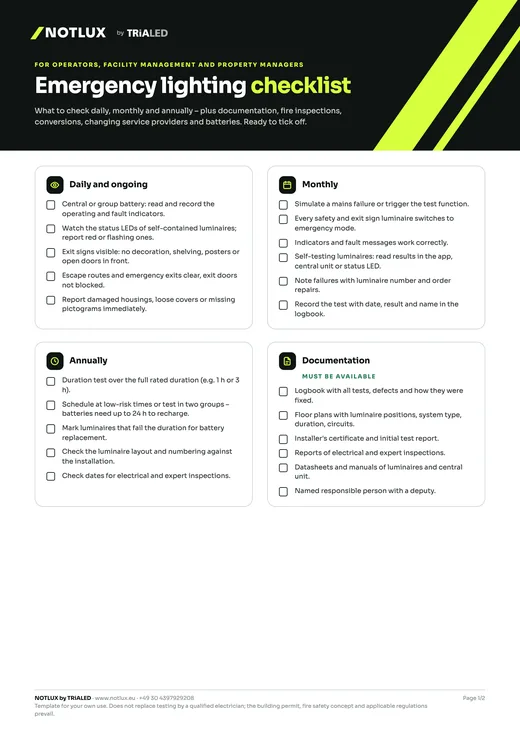
Emergency lighting checklist
2 pages to tick off: daily, monthly, annually – plus documentation, fire inspections, conversions, changing service provider and battery age.
Download PDFFrequently asked questions
How often must emergency lighting be tested?
Under EN 50172, monthly as a function test and annually for the full rated duration. Central battery systems also need a daily visual check of their indicators. National rules add periodic electrical inspections and, for certain buildings, inspections by approved experts.
How long does the monthly function test take?
Only as long as it takes to confirm that every luminaire and exit sign works in emergency mode. The test should not significantly discharge the batteries. Most of the effort comes from walking the building and recording each luminaire.
Why should the duration test not be done during occupied hours?
After the test the batteries are discharged and may need up to 24 hours to reach full rated duration again. If the mains fails during that time, emergency lighting is limited. That is why tests are run at low-risk times or alternately.
How often do experts inspect emergency lighting?
This depends on national law. In Germany, the state inspection ordinances generally require high-risk buildings to be inspected before first use, after major changes and periodically, often every three years. The building permit and local regulations are decisive.
Do self-testing luminaires remove the need for testing?
No. Automatic test systems to EN 62034 take over the function and duration tests, but the intervals still apply. Visual checks, reviewing the records, repairing defects and documentation remain the operator's responsibility.
Emergency lighting without worries.
Luminaires, installation and maintenance from a single source – every inspection documented digitally in our app. We start with a free on-site survey and standard-compliant design.