An emergency lighting logbook is the written record proving that the emergency lighting has been tested regularly and that defects have been fixed, as required by EN 50172:2024. It contains the system data, the defined testing basis, the luminaire schedule, every test with a clear result, defect tracking through to the retest, plus servicing, alterations and inspection reports – including previous years. A digital logbook is generally acceptable if it is complete, traceable, protected against undetected changes and available for inspection at any time.
What is an emergency lighting logbook?
A logbook is the continuous record of all tests, servicing, faults and alterations of an emergency lighting system. EN 50172 requires one to be kept, and the 2024 edition explicitly changed the requirements for tests, handover documentation and the logbook. Example Germany: DIN EN 50172 (VDE 0108-100):2024-10 replaces the 2005-01 edition and the former pre-standard DIN VDE V 0108-100-1:2018-12, with a transition period until 27 May 2027. Other countries have national documents, such as BS 5266-1 in the UK. The logbook is the only reliable evidence that the system was ready for use at the moment that mattered – for authorities, inspection experts, insurers and, after an incident, the courts.
A working system without a logbook is typically recorded as a deficiency during inspections. Conversely, a complete logbook shows that the operator has met its duties. More in operator duties and liability.
What must the logbook contain?
A logbook has two parts: the system's master data and the ongoing entries.
System master data
- Building, operator and responsible person, including a deputy.
- System type: self-contained, group battery or central battery.
- Date of commissioning, installer and handover documentation including the commissioning report (a test report template is available in our downloads).
- Defined testing basis and intervals, e.g. EN 50172:2024 or, for existing installations, older requirements that still apply to the specific building.
- Luminaire schedule with a unique number, location, type and rated duration for each luminaire; for centrally supplied luminaires, also the circuit or central unit and battery.
- Luminaire or escape route plan.
- Date of the last battery replacement per luminaire or battery system.
- For automatic test systems: type of system and scheduled test times.
Ongoing entries
- Date of the test.
- Type of test: monthly function test, annual duration test, 5-yearly illuminance measurement, periodic electrical inspection, expert inspection and – depending on the defined testing basis – further checks such as a daily reading of indicators on central battery systems.
- Clear result (pass / fail), including any luminaires that failed.
- For the annual test: rated duration and duration actually tested.
- Defect tracking: defect ID, luminaire number, description, measure taken, who carried it out, date and retest result.
- Tester, with name and signature or a unique digital identifier.
- Servicing, repairs and alterations: battery replacements, repairs, refurbishments, changed luminaires or escape routes.
- Other events: faults, mains failures with emergency operation.
- Reports: electrical inspection reports, expert inspection reports and the measurement report of the 5-yearly illuminance measurement under EN 50172:2024, section 7.4.5.
Which tests are recorded at which intervals is covered in emergency lighting testing intervals.
Sample entry: what a logbook page can look like
| Date | Test type | Luminaires tested | Result | Defect | Measure, who, when, retest | Tested by |
|---|---|---|---|---|---|---|
| 2026-02-03 | Function test | 1–80 | Fail (79 of 80) | D-2026-01: luminaire 34, status LED red, no emergency mode | Repaired by qualified electrician on 2026-02-05, retest OK | A. Sample, instructed person |
| 2026-03-03 | Function test | 1–80 | Pass | – | – | A. Sample, instructed person |
| 2026-03-07 (Saturday, outside hours of use) | Duration test, rated 3 h, tested 3 h | 1–80 | Fail (79 of 80) | D-2026-02: luminaire 57, emergency mode ended after 2 h 10 min | Substitute measure defined; repaired on 2026-03-09, duration test repeated, OK | M. Example, qualified electrician |
What matters is that every defect is followed through until it is fixed and retested. An entry reading "luminaire 34 faulty" without a follow-up entry is an open item that will be spotted at the next inspection. Defects must be remedied promptly and properly – in Germany, ASR A2.3 requires this without delay.
Practical tip: Number luminaires identically in the building and in the logbook, for example with a label on the housing. Only then can defects be assigned unambiguously and battery replacement dates tracked per luminaire.
How long must the logbook be kept?
There is no single retention period that applies to every building in every country; what counts are the rules for your building, the building permit, national law and, where relevant, your insurer's conditions. The following practice has proven itself:
- The logbook is kept for the entire life of the system and stays on site.
- Entries from previous years remain in the logbook, not just the last twelve months. Only then can the most recent expert inspection, the last 5-yearly measurement and the relevant testing periods be documented without gaps.
- When the operator, owner or tenant changes, the logbook is handed over to the new operator.
When in doubt, keep records longer. After an incident, evidence going back several years may be needed.
Is a digital logbook allowed?
In principle, yes. The standards do not prescribe paper; what matters is that the records serve their purpose as evidence. A digital logbook should meet these requirements:
| Requirement | What it means in practice |
|---|---|
| Complete | All mandatory details as in a paper logbook, for every luminaire and every test |
| Traceable | Time stamps and unambiguous attribution to the tester |
| Tamper-evident | Entries cannot be changed or deleted unnoticed; corrections are logged |
| Available | Can be presented at any inspection, even without special software, e.g. as a PDF export |
| Backed up | Regular backups, access independent of individual employees |
Whether a particular solution is accepted in a given case is decided by the inspecting body. For high-risk buildings, agree the form of documentation with the inspection expert or authority in advance if in doubt.
What are the advantages of a digital or app-based logbook?
- No lost folders: records are stored centrally and available regardless of who is currently responsible.
- Fewer transcription errors: with self-testing luminaires to EN 62034, test results are imported automatically rather than copied by hand.
- Open defects stay visible: unresolved faults remain flagged until closed and retested.
- Fast evidence: an export for authorities, experts or insurers takes minutes.
NOTLUX records maintenance and tests in an app, creating a complete history for every luminaire. How automatic test systems generate entries is explained in self-testing emergency lights. Who may carry out and record which test is covered in who may test emergency lighting.
Checklist: is your logbook ready for inspection?
- Master data, defined testing basis and luminaire schedule are up to date.
- All function and duration tests are recorded, including previous years.
- Annual tests show both the rated duration and the duration actually tested.
- Every defect has an ID and a follow-up entry with measure, date and retest result.
- Testers are identifiable by name.
- Electrical and expert inspection reports and the 5-yearly measurement report are attached.
- The logbook is available on site or digitally at any time.
In practice, the logbook is usually the first thing requested during authority inspections.
Tired of paperwork?
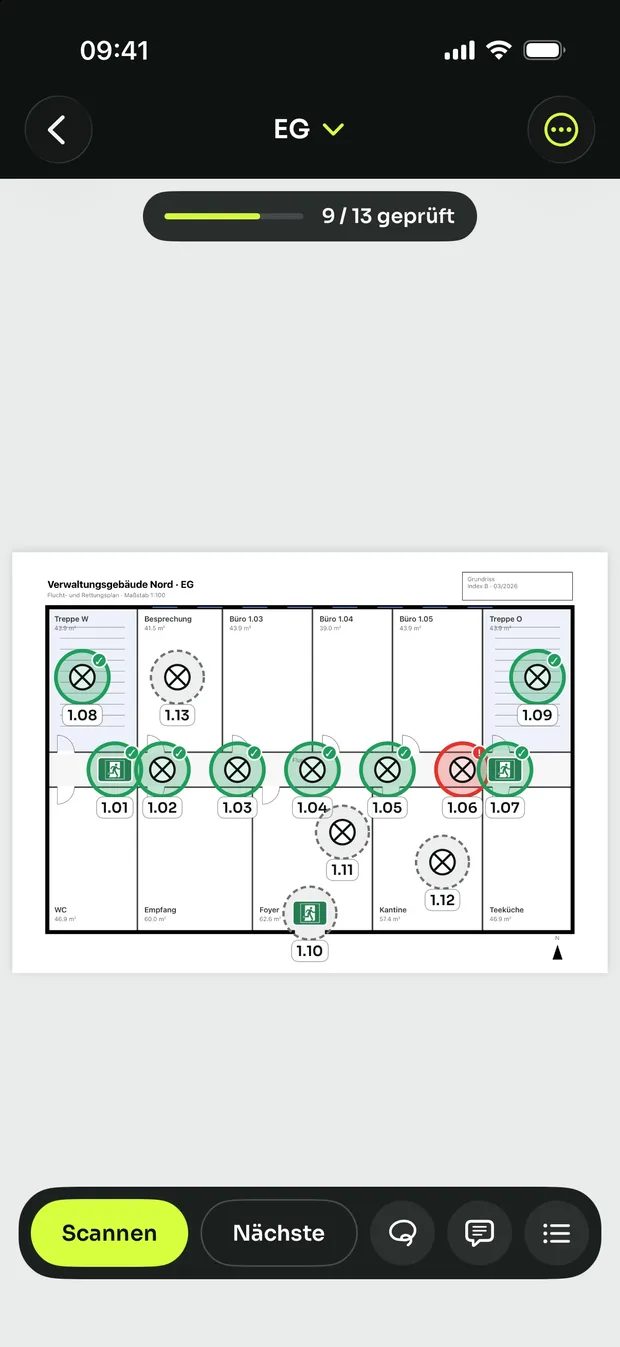
Print, fill in, file, type up – or simply use the app: tap the luminaire on the plan, record defects with a photo, get the report at a click. For existing emergency lighting of any make.
- Import your existing Excel list – no fresh start
- Report ready right after the walk-through, no typing up later
- All sites, luminaires and defects at a glance
- Servers in Frankfurt, GDPR-compliant, works offline

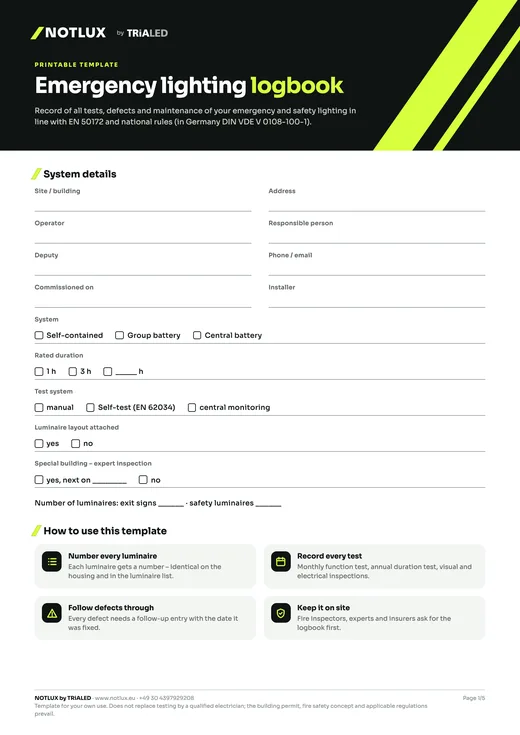
Emergency lighting logbook template
9 pages in line with EN 50172:2024: system details with defined testing basis, intervals and responsibilities, luminaire list, test records, annual test with rated and tested duration, defect log, maintenance and reports, test planning. Record sheets in landscape.
Download PDF Printer-friendly version (saves toner) · 725 KB Also as an Excel template to fill in on your computer · 27 KB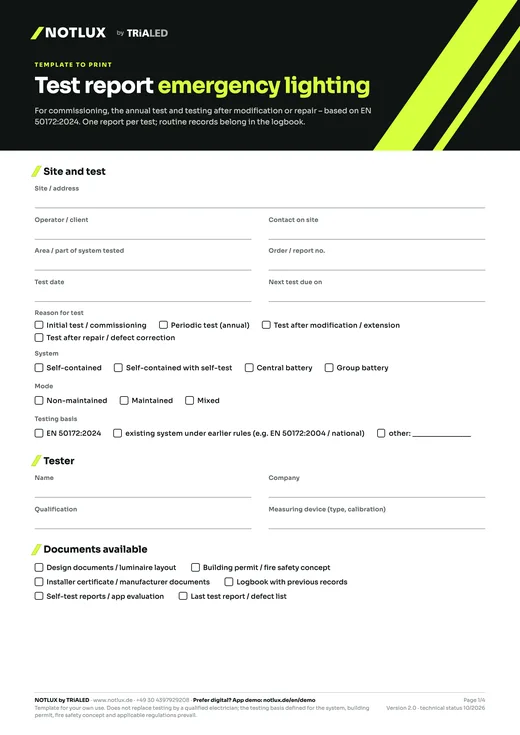
Emergency lighting test report template
4 pages for commissioning, the annual test and testing after modification: reason and testing basis, 12 test items, duration test with rated and achieved duration, illuminance, results per luminaire, rated defects, result and signatures.
Download PDF Printer-friendly version (saves toner) · 461 KB Also as an Excel template to fill in on your computer · 15 KBFrequently asked questions
Is an emergency lighting logbook mandatory?
Yes. EN 50172:2024 requires tests, servicing and faults to be recorded. Without a logbook, the operator cannot prove that the system was ready for use or that its duties were met.
What changed for the logbook with EN 50172:2024?
The 2024 edition changed the requirements for tests, handover documentation and the logbook. Among other things, the report of the 5-yearly illuminance measurement is kept with the logbook. The testing basis and intervals defined for the system should also be recorded.
Can I keep the logbook digitally?
In principle, yes, provided the digital logbook is complete, traceable, protected against undetected changes and available at any time. A PDF export for inspections is advisable. For high-risk buildings, agree the format with the inspecting body beforehand.
Is the report from a self-testing luminaire enough as a logbook?
Automatic test reports to EN 62034 are an important part of the record but do not fully replace the logbook. Visual checks, defect tracking, servicing, alterations and inspection or measurement reports must be added.
How long must the logbook be kept?
There is no single period; the rules for the building are decisive. Good practice is to keep the logbook, including previous years, on site for the whole life of the system and hand it over when the operator changes.
What happens if the logbook has gaps?
Missing entries are recorded as deficiencies during inspections and may lead to follow-up checks. After an incident, there is no evidence that the system was tested and working. Gaps cannot be filled retrospectively – only avoided going forward.

Emergency lighting without worries.
Luminaires, installation and maintenance from a single source – every inspection documented digitally in our app. We start with a free on-site survey and standard-compliant design.