Responsibility for emergency lighting lies with the operator: for workplaces, the employer; under building law, usually the owner or operator of the building. Testing and maintenance can be contracted out, but responsibility for choosing, instructing and supervising the contractor stays with the operator. Without documented proof of regular testing, operators risk fines, problems with insurance cover and, if someone is harmed, civil and criminal consequences.
Who is the operator of an emergency lighting system?
The operator is the person or organisation that bears practical and legal responsibility for running an installation. With emergency lighting, several roles often overlap. The table uses Germany as an example; the pattern is similar in most European countries.
| Role | Basis of responsibility (Germany as example) | Typical duties |
|---|---|---|
| Employer | Occupational Safety Act, Workplace Ordinance | Risk assessment, providing and maintaining safety lighting (ASR A2.3, ASR A3.4) |
| Owner / developer | State building code, building permit | Installing and maintaining the system as permitted; expert inspections in special buildings |
| Tenant / occupier | Lease, own role as employer | Depending on the lease, testing and records in the occupied areas |
| Property or facility manager | Management or service contract | Carrying out and documenting the tasks taken on |
| Installer | Works contract | Installation to standard and handover including documentation |
Across the EU, the Workplace Directive 89/654/EEC requires employers to keep workplaces, including emergency lighting, maintained and in working order. National building codes add the duty to maintain buildings so that life and health are not endangered. Once the system has been handed over, the installer is usually no longer responsible for its ongoing operation; the operator is.
In multi-tenant buildings it is often unclear who is responsible for which luminaires. This gap is one of the most common reasons why tests are missed. Settle the split in writing, in the lease or in a separate agreement.
What exactly must the operator do?
Operator duties fall into four areas:
- Provide: install safety lighting and exit signs wherever the risk assessment, building permit or fire safety strategy requires them (see when emergency lighting is required).
- Test: have the periodic tests under EN 50172 carried out, meaning a monthly function test and an annual full-duration test, plus daily indicator checks for central battery systems. National supplements such as Germany's DIN VDE V 0108-100-1 may add detail.
- Maintain: fix defects without delay, replace batteries and luminaires in time, and adapt the system after refurbishments.
- Document: record every test and every repair in a logbook.
Special buildings may also be subject to expert or authority inspections, see authority inspections.
Can the operator delegate these duties to a contractor?
The work, yes; the responsibility, not entirely. If you contract out testing and maintenance, you only meet your obligation if you ensure three things:
- Careful selection: the contractor must be competent. Testing electrical installations usually requires a qualified electrician or competent person, see who may test emergency lighting.
- Clear instructions: scope, intervals and documentation must be agreed in writing. A contract that only says "annual maintenance" does not cover the monthly function test.
- Supervision: the operator must check that the agreed work is actually done, for example by reviewing the test reports.
Within an organisation, duties can also be assigned to reliable and competent staff. Example Germany: under Section 13(2) of the Occupational Safety Act, the employer may assign tasks in writing to such persons, but senior management retains a duty of supervision.
Practical tip: Name in writing who is responsible for emergency lighting in your building, including a deputy. Incomplete logbooks almost always start when that person leaves and nobody takes over the task.
Why is documentation so decisive?
After an incident, the key question is not whether emergency lighting was installed but whether it was demonstrably in working order. Only the records can prove that. Without a logbook, an operator will find it hard to show authorities, insurers or a court that the duties were met.
A paper logbook is as valid as a digital record, provided it is complete, traceable and protected against later alteration. Digital logbooks have the advantage that entries with date and luminaire reference are created automatically and do not get lost. Contents and structure are covered in emergency lighting logbook.
What are the consequences of non-compliance?
Consequences depend on national law and the individual case. In general, the following areas come into play; German provisions are given as examples.
| Area | Possible consequences |
|---|---|
| Administrative offences | Fines under workplace safety and building law; in Germany also for failure to supervise within a company (Section 130 OWiG) |
| Official measures | Orders to remedy defects, penalty payments and, where there is danger, prohibition of use up to temporary closure |
| Insurance | If contractual obligations are breached, insurers may reduce or, in serious cases, refuse payment; in Germany governed by Section 28 of the Insurance Contract Act (VVG) |
| Civil liability | Damages for breach of the duty of care towards occupiers and visitors, or of contractual duties towards tenants, guests or customers |
| Criminal law | Where people are injured or killed, responsible individuals may face investigation for negligent bodily harm or negligent homicide |
Whether and to what extent such consequences arise always depends on whether a duty was breached, whether the breach caused the damage and how serious the fault was. Complete records are the most effective way to show that duties were fulfilled.
How should responsibility be organised?
A robust organisational model for emergency lighting includes:
- Assign responsibility: name a responsible person and a deputy, in writing, with a clear task description
- Know the requirements: keep the building permit, fire safety strategy and risk assessment available and up to date
- Record the inventory: luminaire list with location, type, year of installation and battery age
- Sign a maintenance contract: with clearly defined intervals, services and documentation duties
- Track deadlines: own tests, expert inspections and battery replacements in one shared calendar
- Use a digital logbook: records stored centrally, tamper-evident and available at any time
- Follow up defects: each defect with a deadline, owner and proof of completion
- Report changes: pass on refurbishments and changes of use to the responsible person early
Self-testing luminaires reduce the organisational effort because function and duration tests run and are logged automatically. NOTLUX records testing and maintenance in a digital logbook via its app and, with its maintenance contract, takes care of the annual on-site inspection, replacement of all batteries in year 5 to 6 and repairs. Visual inspections and overall responsibility remain with the operator.
This article is a general overview and is not legal advice for your specific situation.
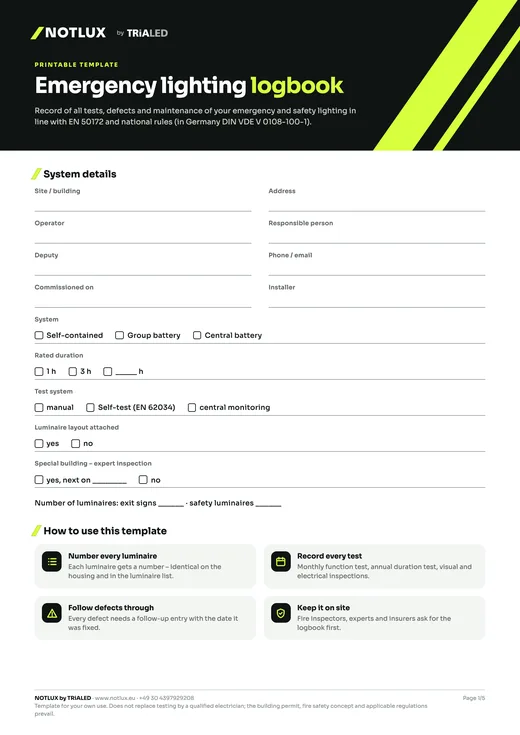
Emergency lighting logbook template
5 printable pages: system details, luminaire list with battery replacement dates, test records with a sample entry, testing intervals at a glance and an inspection-readiness check.
Download PDFFrequently asked questions
Who is liable if the maintenance contractor misses a test?
The contractor is liable to the operator under the contract. Towards authorities and injured parties, however, the operator remains responsible if the contractor was not carefully chosen, clearly instructed or supervised. Review the test reports yourself at regular intervals.
Is the landlord or the tenant responsible for emergency lighting?
That depends on the lease and on each party's role. Under building law the owner is usually responsible; under workplace safety law the tenant is responsible for its own employees. Without a clear contractual split, gaps easily arise that neither party closes.
Is a digital logbook acceptable as proof?
Yes, provided it is complete, traceable and protected against later alteration. EN 50172 does not require paper. What matters is that the date, type of test, result, remedial action and the person testing are recorded.
Can an insurer refuse to pay if tests were not carried out?
That depends on the policy terms and the individual case. If the policyholder breaches agreed obligations, insurers can reduce or refuse payment depending on the degree of fault, typically only where the breach contributed to the loss. Check your policies for safety requirements relating to emergency lighting.
Do small businesses have the same obligations?
If safety lighting is installed or required, the testing and record-keeping duties apply regardless of company size. With only a few luminaires the effort is modest, particularly with self-testing luminaires.
Emergency lighting without worries.
Luminaires, installation and maintenance from a single source – every inspection documented digitally in our app. We start with a free on-site survey and standard-compliant design.