Responsibility for testing emergency lighting generally lies with the building operator – in workplaces, the employer – while the tests themselves may be carried out by different people depending on their type. The annual duration test and electrical inspections belong in the hands of a qualified electrician, instructed persons may read indicators, operate the test button or test function provided and record the results. Opening luminaires, replacing batteries or switching circuits is a job for a qualified electrician, and in certain high-risk buildings approved experts inspect in addition.
Who is responsible for testing?
The operator is the person or organisation in actual control of the building and its installations – for example the owner, a tenant occupying a whole building, or the employer. The operator must ensure that the emergency lighting remains functional, is tested on time and that the tests are recorded. EN 50172 sets the European baseline for testing and records; national occupational safety and building law define who carries the duty in each country. In Germany, for example, this follows from the Occupational Safety and Health Act, the Workplace Ordinance, the Ordinance on Industrial Safety and Health and state building law, together with DIN EN 50172 (VDE 0108-100):2024-10, which replaces the 2005-01 edition and the former pre-standard DIN VDE V 0108-100-1.
The key distinction is between responsibility and execution. Execution can be delegated to in-house staff or a service provider. Responsibility for making sure testing happens stays with the operator, who must select suitable people, instruct them clearly and check their work on a sample basis. In leased buildings, the lease should state who takes on which testing duty. More in operator duties and liability.
Who can carry out the tests?
Qualified electrician
A qualified electrician (in German practice: Elektrofachkraft under DIN VDE 1000-10 and DGUV Regulation 3) is a person who, through technical training, knowledge, experience and familiarity with the relevant standards, can assess the work assigned and recognise possible hazards. This person carries out the annual duration test, periodic electrical inspections, repairs and battery replacement, evaluates defects and defines temporary measures where needed. Any work that involves opening luminaires, switching circuits or working on the electrical installation belongs in their hands.
Electrically instructed person
An electrically instructed person has been briefed by a qualified electrician on the tasks assigned and on the hazards of improper behaviour. Such a person may work on the electrical installation only under the direction and supervision of a qualified electrician (in Germany, cf. BG BAU and DGUV guidance). The electrician decides which tasks are delegated and evaluates the results.
Instructed staff of the operator
For tasks that do not involve working on the electrical installation, instruction is usually enough. Instructed persons may read indicators – such as the status LED of a self-contained luminaire or, depending on the defined testing basis, the indicators of a central battery system – operate the test button or test function provided by the manufacturer and record the results in the logbook. They also check that exit signs are visible and undamaged and report anything unusual. They do not open luminaires, replace batteries, switch circuits or fix electrical faults.
Approved inspection experts
Many countries require independent inspections for certain building types. In Germany, Prüfsachverständige for electrical installations are experts recognised under state law who inspect safety installations in high-risk buildings (Sonderbauten) on behalf of the operator. State inspection ordinances generally require their inspection before first use, after major changes and periodically, often every three years. They do not replace the operator's monthly and annual tests; among other things, they check that those tests have been done. Details in authority inspections.
Competence table: who may do what?
| Test | Instructed staff | Electrically instructed person | Qualified electrician | Approved expert |
|---|---|---|---|---|
| Reading indicators (e.g. daily on central systems, depending on testing basis) | Yes | Yes | Yes | Not their task |
| Condition check (damage, visibility) | Yes | Yes | Yes | As part of their inspection |
| Monthly function test via test button/test function, recording the result | Yes | Yes | Yes | Not their task |
| Annual duration test | No | May assist | Yes, including evaluation | Not their task |
| Illuminance measurement every 5 years | No | May assist | Yes | Not their task |
| Opening luminaires, switching circuits, battery replacement, repair | No | Only under direction and supervision of a qualified electrician | Yes | No |
| Periodic inspection of the electrical installation | No | No | Yes, as a competent tester | No |
| Building-law inspection of high-risk buildings | No | No | No | Yes |
The table reflects common practice, using Germany as the reference. In each case the risk assessment, manufacturer's instructions, the testing basis defined for the system and national law decide. The matching intervals are set out in emergency lighting testing intervals.
Practical tip: Record in writing who in the building is responsible for emergency lighting, who deputises and which external contractor is engaged. Gaps in documentation very often start with a change of staff.
In-house staff or service provider?
Whether to organise testing internally or outsource it depends mainly on the size of the installation and the electrical expertise available.
- In-house staff make sense if a qualified electrician is on site and the installation is manageable. Advantage: short response times and local knowledge.
- A specialist contractor suits buildings without a qualified electrician, with many distributed luminaires or with luminaires that require access platforms. Advantage: routine, spare parts and documentation from one source.
- A mixed model: instructed staff handle visual checks, trigger function tests via the test button or read self-testing luminaires, and record the results; the contractor carries out the annual test and repairs.
Self-testing luminaires to EN 62034 shift the workload: the luminaire runs the tests, people evaluate the results and fix defects. More in self-testing emergency lights.
Checklist: choosing a testing provider
- Qualifications: evidence that tests are carried out by qualified electricians with experience of emergency lighting to EN 50172:2024 and the relevant national rules, including transition arrangements for existing systems.
- System knowledge: experience with your system type (self-contained, group or central battery) and luminaire brands.
- Scope: clearly stated whether the contract covers testing only or repairs as well, including battery replacement and spare parts.
- Documentation: format of the test report, transfer into the logbook, digital and exportable on request.
- Response time: binding deadlines for fixing defects found, which must be remedied promptly and properly.
- Liability insurance: proof of public and professional liability cover.
- Site survey: reputable providers inspect the installation on site before quoting rather than pricing per luminaire on paper.
NOTLUX supplies and installs emergency lighting and also handles maintenance: the maintenance contract includes one on-site inspection per year, replacement of all batteries in year 5–6 and repairs during the term, with every test recorded digitally in an app. Every quote is preceded by an on-site survey. Typical maintenance cost drivers are covered in emergency lighting costs.
This article does not replace legal advice. The requirements for your building follow from the risk assessment, building permit, fire safety strategy and national law.
Tired of paperwork?
Print, fill in, file, type up – or simply use the app: tap the luminaire on the plan, record defects with a photo, get the report at a click. For existing emergency lighting of any make.
- Import your existing Excel list – no fresh start
- Report ready right after the walk-through, no typing up later
- All sites, luminaires and defects at a glance
- Servers in Frankfurt, GDPR-compliant, works offline

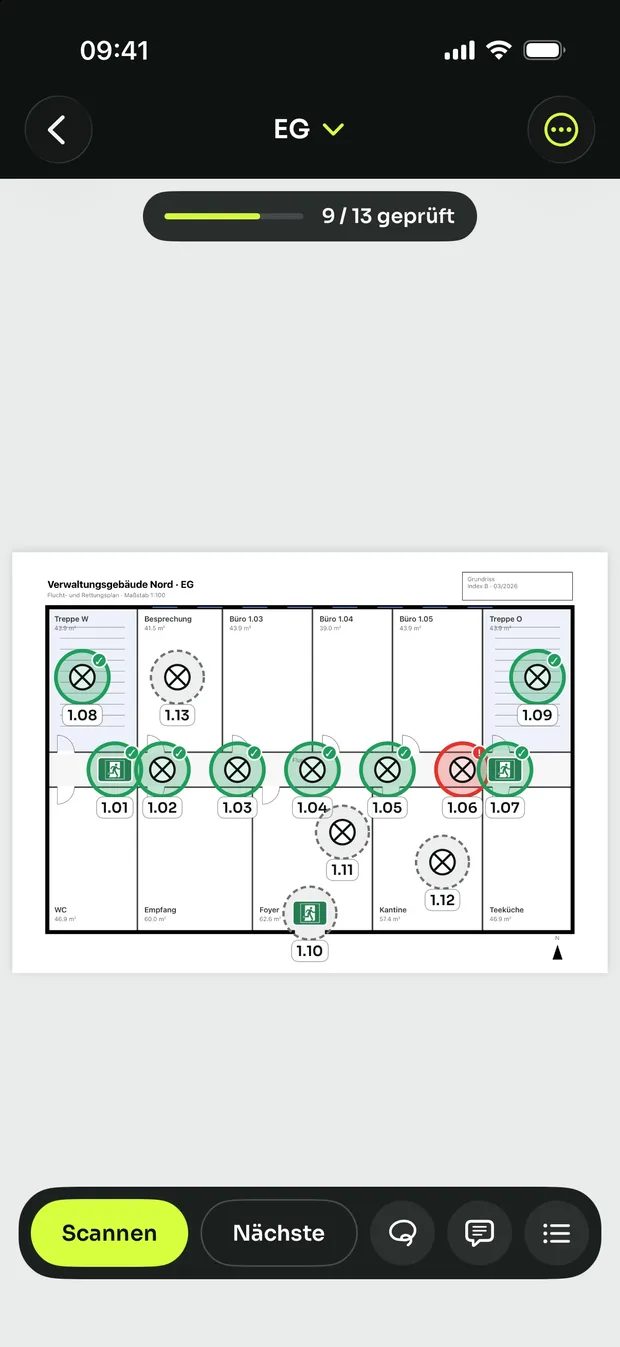
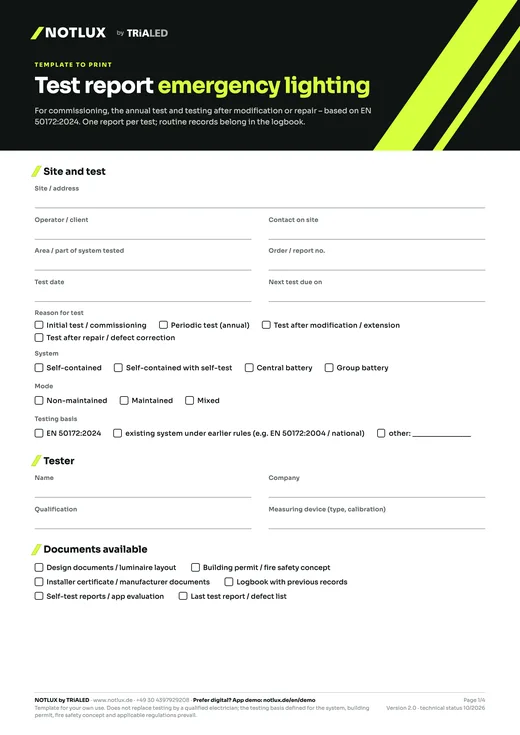
Emergency lighting test report template
4 pages for commissioning, the annual test and testing after modification: reason and testing basis, 12 test items, duration test with rated and achieved duration, illuminance, results per luminaire, rated defects, result and signatures.
Download PDF Printer-friendly version (saves toner) · 461 KB Also as an Excel template to fill in on your computer · 15 KBFrequently asked questions
May the caretaker test the emergency lighting?
As an instructed person, a caretaker may read indicators, operate the test button or test function provided and record the results. Opening luminaires, replacing batteries, switching circuits and repairs belong with a qualified electrician. The annual duration test is normally the responsibility of a qualified electrician too.
Does an expert have to inspect emergency lighting every year?
Not in general. Inspections by approved experts are required for certain building types under national law – in Germany, for high-risk buildings, often every three years. Monthly and annual tests are carried out by the operator or their qualified electrician.
When is an approved expert (Prüfsachverständiger) needed?
In Germany, an approved expert (Prüfsachverständiger) must inspect safety lighting mainly in high-risk buildings such as places of assembly, large retail premises, high-rise buildings or large car parks, as set out in the federal states' inspection ordinances. The inspection usually takes place before first use, after significant changes and periodically, often every three years. Ordinary office buildings generally do not need one unless the building permit requires it. The expert inspection does not replace the operator's monthly and annual tests.
Can I hand the testing duty over to a contractor?
You can delegate execution, but not your responsibility entirely. The operator must choose a suitable contractor, instruct them clearly and check that tests actually take place and are recorded.
What is the difference between a qualified electrician and an instructed person?
A qualified electrician can assess work on electrical installations independently, based on training, experience and knowledge of the standards. An electrically instructed person has been briefed by a qualified electrician for specific, clearly defined tasks and may work on the electrical installation only under their direction and supervision.
Who tests self-testing emergency lights?
The luminaire carries out function and duration tests automatically. An instructed person can read and record the results; faults are fixed by a qualified electrician. Visual checks, the annual check of condition and soiling and the 5-yearly measurement remain necessary.

Emergency lighting without worries.
Luminaires, installation and maintenance from a single source – every inspection documented digitally in our app. We start with a free on-site survey and standard-compliant design.