Under EN 50172, operators of emergency lighting check central battery indicators daily, test every luminaire in emergency mode monthly and run a full rated-duration test annually; national rules such as DIN VDE V 0108-100-1 in Germany add detail. Every test and every defect is recorded in the logbook. On top of that, targeted checks are due before authority inspections, after alterations, when changing service provider and as batteries age.
Who is this checklist for?
This checklist is for building operators, facility managers, property managers and employers responsible for an existing emergency lighting system. The operator is the person or organisation legally responsible for the safe operation of the system – even when testing is contracted out. Duties are explained in Operator duties and liability, and the intervals in detail in Emergency lighting testing intervals.
Which tests are mandatory for your building depends on its use, the building permit, the fire strategy and national law. The points below reflect common European practice based on EN 50172, with German rules as an example where noted.
Who – what – when: the overview
| Who | What | When |
|---|---|---|
| Instructed staff | Read the indicators of the central or group battery system | daily |
| Operator or instructed person | Visual check: luminaires and signs undamaged, not obstructed | ongoing, e.g. on walk-rounds |
| Competent person (electrician or instructed person, depending on system) | Functional test of all luminaires in emergency mode | monthly |
| Competent person, usually a qualified electrician | Full rated-duration test | annually |
| Qualified electrician | Periodic inspection of the electrical installation | per national rules or risk assessment (in Germany e.g. DGUV Regulation 3) |
| Approved expert | Inspection of high-risk buildings where national law requires it | in Germany typically before commissioning, after major changes and often every 3 years |
| Operator | Review results, commission repairs | after every test |
Daily and ongoing
- With central or group battery systems: read the status and fault indicators and record the result.
- Watch the status LEDs of self-contained luminaires on walk-rounds and report red or flashing indicators (see Emergency light flashing red).
- Check exit signs are visible: no decorations, shelving, posters or open door leaves in front of them.
- Keep escape routes and emergency exits clear and exit doors unobstructed.
- Report damaged housings, loose diffusers or missing pictograms immediately.
Monthly
- Simulate a failure of the normal supply or trigger the test function.
- Check that every emergency luminaire and every exit sign switches to emergency mode.
- Check that indicators and fault signals work correctly.
- With self-testing luminaires: read results in the app, the control panel or at the status LED instead of testing each luminaire manually.
- Note failed luminaires by number and commission repairs.
- Record the test with date, result and name in the logbook.
Annually
- Run a test over the full rated duration (for example 1 h or 3 h).
- Schedule it for low-risk times or test luminaires alternately in two groups, as batteries need up to 24 hours to recharge afterwards.
- Mark luminaires that fail to reach the duration for battery replacement.
- Compare the luminaire plan and numbering with what is installed.
- Check the dates of electrical inspections and any expert inspections.
Records: what must be available?
- Logbook with all tests, results, defects and the date they were fixed (see Emergency lighting logbook).
- System documentation: floor plans with luminaire positions and numbers, system type, rated duration, circuits.
- Installer's completion certificate and commissioning test report.
- Reports from electrical and expert inspections, including proof that defects were remedied.
- Data sheets and instructions for luminaires and control equipment.
- Named responsible person on site, with a deputy.
A digital logbook makes complete records easier, provided entries are traceable and cannot be altered unnoticed. NOTLUX, for example, records maintenance in an app, and the luminaires' self-test results can be exported as a test report.
Before an authority or expert inspection
- Check the logbook is complete: are all months and the last annual test recorded?
- Fix open defects from earlier inspections and document the repairs.
- Carry out your own functional test shortly before the date.
- Walk the escape routes and signs: clear, visible, arrows correct.
- Keep documents to hand and ensure access to control panels, plant rooms and hard-to-reach luminaires.
What inspectors typically want to see is explained in Authority inspections.
After alterations or a change of use
- Check whether escape routes, exits or room layout have changed.
- Check arrow directions and positions of exit signs.
- Record new obstructions such as partitions, shelving or acoustic panels.
- Clarify whether the new use triggers different requirements, such as anti-panic lighting or a longer rated duration.
- Update the luminaire plan, calculation and evacuation plans.
- For major changes in high-risk buildings, consider whether a new expert inspection is required.
When changing service provider
- Require full handover of the logbook, system documentation and latest test reports.
- Record open defects and ongoing repairs in writing.
- With digital logbooks, ensure the data can be exported.
- Have access credentials for the control panel, app or monitoring software handed over.
- Fix the date of the next tests due so there is no gap.
Battery age and spare parts
- Record the installation year of batteries per luminaire or group.
- NiCd and NiMH batteries are often replaced after about four to five years; LiFePO4 batteries usually last longer, but the data sheet is binding (more in Emergency light battery).
- Compare annual duration test results over the years and replace batteries by group before they fail.
- Keep spare batteries and pictograms of the installed type in stock or confirm availability.
- If spare parts are no longer available, plan an upgrade of the system.
Tip: Keep a copy of this checklist with the logbook and tick off the points at every test. That way a deputy can see at once what needs doing.
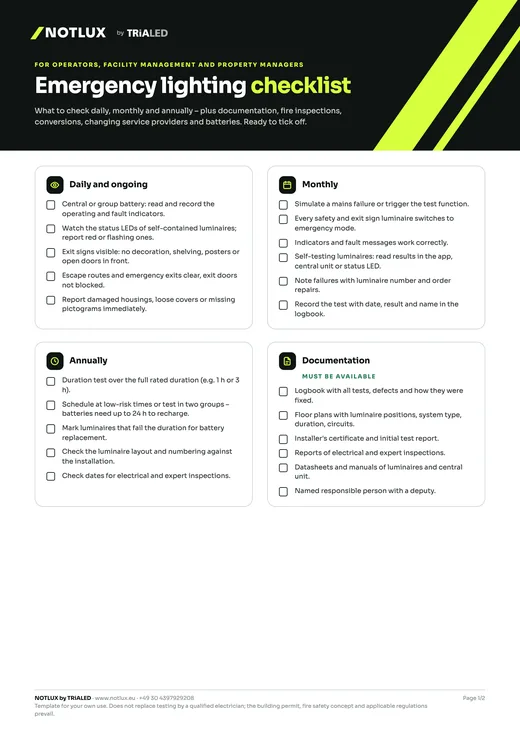
Emergency lighting checklist
2 pages to tick off: daily, monthly, annually – plus documentation, fire inspections, conversions, changing service provider and battery age.
Download PDFFrequently asked questions
What must the operator check personally?
The operator is responsible for all tests being carried out, even when they are contracted out. Instructed staff can usually handle daily visual checks and, depending on the system, the monthly functional test. Annual tests and electrical inspections belong with a qualified electrician.
What happens if a luminaire fails a test?
The luminaire is entered in the logbook with its number and repaired promptly. Until it is fixed, check whether the escape route concerned is still adequately lit. The repair is recorded with its date.
Do self-testing luminaires replace this checklist?
No. Automatic test systems to EN 62034 carry out the functional and duration tests, but visual checks, reviewing results, remedying defects and record keeping remain the operator's job.
How long must the logbook be kept?
There is no single Europe-wide period; the rules applying to your building and any insurer requirements are decisive. A sound practice is to keep records that cover at least the period since the inspection before last without gaps.
What should I consider after a change of use?
A new use can trigger different requirements for illuminance, rated duration or escape routes. Check the building permit and fire strategy, and have the system assessed and adapted by a specialist where necessary.
Emergency lighting without worries.
Luminaires, installation and maintenance from a single source – every inspection documented digitally in our app. We start with a free on-site survey and standard-compliant design.